

One of the most common questions I hear from families at their first estate planning meeting is a simple one: Do I need a will or a trust? What is actually the difference?
It is a reasonable question. And the honest answer for most families is: you need both. But they do completely different jobs, and confusing one for the other is exactly how families end up in probate court when they believe everything was taken care of.
In this post, I will walk through exactly what a Last Will and Testament does, what a Revocable Living Trust does, why one does not replace the other, and how to know which documents your specific family needs.
As a licensed estate planning attorney in both New York and Connecticut, and a financial advisor serving the entire country, who has coordinated legal and financial planning for families for over 30 years, this is territory I cover with nearly every client.
A will is a legal document that expresses your wishes for what happens to your assets and your family after you die. It has no power during your lifetime. It only takes effect at death.
A will can do several things:
Here is what most people do not fully understand: a will does not avoid probate. A will goes through probate.
Probate is the court-supervised process of validating your will and overseeing the distribution of your estate. In Connecticut and New York, probate can take 12 to 18 months or longer depending on estate complexity. Court costs and fees typically run 3% to 7% of the estate’s gross value. And probate is public record, anyone can look up your will, your assets, and your beneficiaries.
This is not a fatal flaw. Wills work. For simple estates, probate is manageable. But for families with significant assets, real estate in multiple states, a blended family, or a desire for privacy, relying solely on a will is often not the right strategy.
A revocable living trust is a legal arrangement you create during your lifetime. You transfer assets into the trust, retitling your home, investment accounts, and other property into the name of the trust, and you serve as your own trustee, maintaining full control while you are alive and competent.
When you die or become incapacitated, a successor trustee you named in advance takes over and manages or distributes the trust assets according to your instructions, without any court involvement. That last part is the core difference.
A revocable living trust cannot name guardians for your minor children. Only a will can do that. This is the primary reason families with children virtually always need both documents.
A standard revocable living trust also does not reduce estate taxes. Because you retain full control of the assets, they remain part of your taxable estate. Irrevocable trusts, which permanently remove assets from your estate, and address estate tax reduction for high-net-worth families. But that is separate from the standard revocable trust used for probate avoidance and asset management.
| Last Will and Testament | Revocable Living Trust |
| Takes effect only at death | Takes effect immediately when signed and funded |
| Goes through probate court | Bypasses probate entirely |
| Becomes public record | Remains completely private |
| Can name guardians for minor children | Cannot name guardians, will is required for this |
| No protection during incapacity | Successor trustee manages assets if you are incapacitated |
| Governs assets titled in your name | Controls only assets formally transferred into the trust |
| Less expensive to create | More complex and expensive to set up, and must be funded |
| Required in any complete estate plan | Strongly recommended for most families with real estate or significant assets |
| Does not reduce estate taxes | Does not reduce estate taxes (irrevocable trusts do) |
| Simple to update during life | Requires updating trust document and asset titling over time |
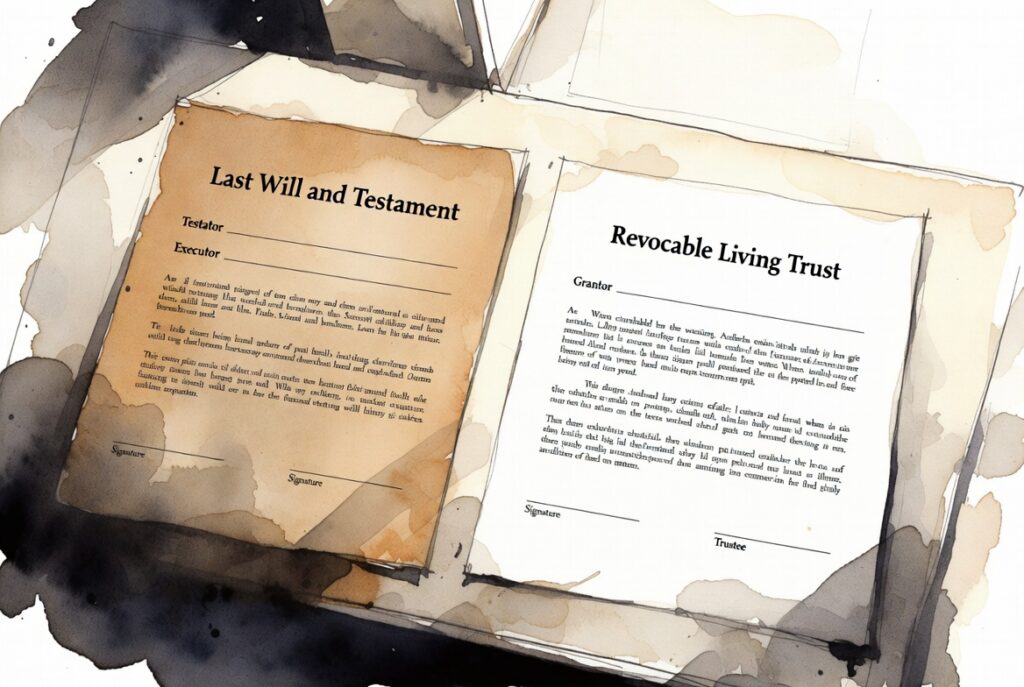
The short answer for most families: both a will and a revocable living trust, plus a durable power of attorney and healthcare documents. But the right mix depends on your specific situation.
| Your Situation | What You Need | Why It Matters |
| You have minor children | Will (essential) + Trust (recommended) | Only a will names guardians. A trust ensures assets are managed properly if both parents die. |
| You own real estate | Will + Funded Trust | Property titled in your name alone goes through probate. A trust eliminates this. |
| You own property in multiple states | Will + Trust (critical) | Without a trust, you face separate probate in each state. This alone justifies funding a trust. |
| You are in a blended family | Will + Trust + careful drafting | Trusts let you provide for a surviving spouse while protecting assets for children from a prior marriage. |
| Your NY estate exceeds $7.35M | Will + Trust + advanced planning | NY’s estate tax cliff means careful planning, estates between 100-105% of the $7.35M exemption face full taxation from dollar one. |
| You want privacy | Will + Trust | Wills are public record. Trust distributions are not. |
| You are concerned about incapacity | Will + Trust + Durable POA | A will does nothing if you are alive but incapacitated. A funded trust and durable POA together cover this scenario. |
| Accounts with beneficiary designations | Will + Updated beneficiary forms | IRAs and 401(k)s pass through beneficiary designation, outside both will and trust. These must be coordinated with your plan. |
| Simple estate, no real estate | Will may be sufficient | For genuinely simple situations, a well-drafted will with updated beneficiary designations can be adequate. |
When you establish a revocable living trust, your attorney will typically also draft a pour-over will alongside it. This document has a specific purpose.
No matter how carefully you fund your trust, there is almost always some asset that ends up outside it, a small account you forgot to retitle, personal property, or an asset acquired after the trust was created. A pour-over will instructs that anything you own at death that is not already in the trust gets poured into it, so your entire estate ultimately falls under the trust’s distribution instructions.
The pour-over will still goes through probate for those specific unfunded assets. But it acts as a backstop. Think of your trust as the plan and your pour-over will as the safety net.
A complete estate plan for most families includes five documents, not just two.
| 1. Revocable Living Trust Your primary tool for asset management, probate avoidance, and privacy. Controls all assets titled in the trust during your lifetime and at death. Activates immediately, including if you become incapacitated. |
| 2. Pour-Over Will Works alongside your trust. Names guardians for minor children (critical if you have kids). Catches any assets not transferred into the trust before death and directs them into it. |
| 3. Durable Power of Attorney Authorizes someone you trust to manage your financial affairs if you are alive but incapacitated, without court involvement. Without this, your family may need a court-appointed conservator to pay your bills or manage your accounts. |
| 4. Healthcare Proxy (Healthcare Power of Attorney) Authorizes someone to make medical decisions on your behalf if you cannot make them yourself. Applies only to healthcare decisions, separate from the financial power of attorney. |
| 5. Living Will (Advance Healthcare Directive) States your wishes regarding life-sustaining treatment, end-of-life care, and specific medical interventions if you are in a terminal condition or permanently unconscious. Works alongside the healthcare proxy. |
Most families focus on the trust and will, and discover they needed all five when an emergency actually happens. Setting up all five documents at once is significantly more cost-effective than addressing each one reactively.
| Ready to Build Your Estate Plan? John F. Davenport, Esq. is a licensed estate planning attorney in New York and Connecticut. He helps families build complete plans that coordinate legal documents with their overall financial strategy. Through our network, we can also help you if you live anywhere in the country. -> Schedule a Free Estate Planning Review -> jdavenportassociates.com/contact-us |
Because Davenport & Associates serves families in both states locally, and through our network, the entire country. Here are the meaningful differences that affect estate planning decisions:
This is the error I see most often: a family pays an attorney to draft a trust, signs all the documents, and never transfers their assets into it. The trust is empty.
An unfunded trust does not avoid probate. It does not protect you during incapacity. It does nothing except sit in a drawer.
Funding a trust means retitling your assets into the trust’s name. Your home deed needs to be changed. Investment accounts need to be retitled. Bank accounts need to be moved. If your attorney or advisor did not walk you through this process, or if your trust is several years old, it is worth reviewing whether it is actually funded.
Here is what typically needs to be transferred into a revocable living trust:
Note: Retirement accounts (IRAs, 401(k)s) are generally NOT retitled into a revocable trust. These are what are known as “non probate assets” as they pass through beneficiary designations, which must be coordinated with your overall plan but typically name individuals, not the trust itself, as beneficiaries.
These are the questions I hear most consistently from families starting the estate planning process.
| Q: What is the main difference between a will and a revocable living trust? |
| A will takes effect only after you die and goes through probate court, which is public, time-consuming, and typically costs 3%-7% of the estate’s gross value in CT and NY. A revocable living trust takes effect immediately when signed and funded, bypasses probate entirely, remains private, and also protects you if you become incapacitated during your lifetime. The core difference: a will sends your estate through court; a trust does not. |
| Q: Do I need both a will and a revocable living trust? |
| For most families with real estate, minor children, significant assets, or property in multiple states, yes. The trust is your primary tool for probate avoidance and incapacity protection. The will (typically a pour-over will) is essential for naming guardians for minor children and catching any assets not in the trust at death. They work together as a complete plan. |
| Q: Does a will avoid probate? |
| No. A will goes through probate, it is the document the court uses to oversee distribution of your estate. A revocable living trust is the tool that avoids probate. Assets held in the trust pass directly to beneficiaries without court involvement. |
| Q: Can a trust reduce my estate taxes? |
| A standard revocable living trust does not reduce estate taxes on its own, because you retain full control of the assets and they remain part of your taxable estate. Irrevocable trusts, which permanently remove assets from your estate, are the primary tool for estate tax reduction. In 2026, the federal estate tax exemption is $15 million per person, so federal estate taxes only affect very large estates. New York’s state estate tax applies above $7,350,000, with a significant cliff that makes NY-specific planning important for families in the $7M-$10M range. |
| Q: What is a pour-over will? |
| A pour-over will is drafted specifically to work alongside a revocable living trust. It instructs that any assets you own at death that are not already in your trust get poured into it, ensuring your entire estate falls under the trust’s distribution instructions. Those specific unfunded assets still go through probate but, the trust acts as the destination and distribution mechanism. |
| Q: What happens if I create a trust but never fund it? |
| An unfunded trust does nothing. Assets not transferred into the trust will go through probate as if the trust did not exist, governed by your will or by state law. Funding the trust (retitling your home, accounts, and other assets into the trust’s name) is just as important as creating it. |
| Q: Does a power of attorney replace a trust? |
| No, they serve different functions. A durable power of attorney authorizes someone to act on your behalf for financial matters if you are alive but incapacitated. A trust does the same, with the added benefit that trust assets bypass probate at death. For comprehensive planning, most people carry both: a funded trust and a durable POA covering assets not held in the trust. |
| Q: How much does a revocable living trust cost in Connecticut or New York? |
| A complete trust-based estate plan, including the revocable trust, pour-over will, durable POA, and healthcare documents, typically ranges from $2,500 to $6,000+ in CT and NY depending on complexity. More complex situations involving blended families, business interests, multi-state property, or tax planning cost more. The upfront cost is typically far less than the probate costs it avoids. |
The question is not will or trust. For most families, the question is how to structure both, and how to make sure everything else (power of attorney, healthcare documents, beneficiary designations) is coordinated with them.
A will alone leaves your estate in probate, visible to the public, and does nothing to protect you during incapacity. A trust alone cannot name guardians for your children, and leaves any unfunded assets in probate anyway. Together, structured and funded correctly, they form the foundation of a complete estate plan.
After 30 years as both an estate planning attorney and a financial advisor, the families I have seen protected all share one thing: they did not wait, and they did not assume it was handled. They built the plan and kept it current.
| Ready to Review or Build Your Estate Plan? John F. Davenport, Esq. is licensed in New York and Connecticut and coordinates legal and financial planning as a single integrated strategy. Free 15-minute consultation.-> Book Your Free Estate Planning Review -> jdavenportassociates.com/contact-us |
| References & Sources: Estate Tax Exemption 2026 ($15M per person) – One Big Beautiful Bill Act, signed 2025 New York State Estate Tax 2026 ($7,350,000 exemption with tax cliff) – NY Tax Law Section 952 Connecticut Estate Tax – Eliminated January 1, 2023 (CT DRS confirmation) Probate cost estimates (3-7%) – CreativePlanning.com, Baron Law, NerdWallet (March 2026 research) Revocable vs. irrevocable trusts – Charles Schwab, FindLaw, NerdWallet, NCOA Pour-over will definition and function – Trust & Will, CreativePlanning, Guardian Life Trust funding requirements – Charles Schwab, Western & Southern, CreativePlanning |
| About the Author – John F. Davenport, Esq. John F. Davenport holds a law degree from Pace University, an MBA in finance from Fordham University and undergraduate degree from the University of Notre Dame. He is a licensed attorney in New York and Connecticut, and holds FINRA Series 6, 7, 63, and 65 licenses. He founded Davenport & Associates in 1997 and has spent more than 30 years helping CT and NY locally and families across the country build retirement income plans and estate strategies that work together, not against each other. Davenport & Associates is located at 800 Connecticut Avenue, Suite E401, Norwalk, CT 06854. Phone: (203) 853-6300 | jdavenportassociates.com IMPORTANT DISCLAIMER: Educational only—not investment/tax/legal advice. No strategy guarantees results—vary by rates, markets, laws, personal circumstances. Consult advisors. |