

By John F. Davenport, Esq. | Davenport & Associates, Norwalk, CT | May 7, 2026
The S&P 500 finished 2025 with an 18 percent total return. Then 2026 arrived. Through early April, the index was down roughly 4 percent. The VIX, a widely followed measure of market fear, had already traded as high as 35 over the past 12 months.
If you are still in the accumulation phase, years or decades from retirement, this kind of volatility is mostly noise. Your contributions keep buying shares at lower prices. You have time to recover. You have the wind at your back.
But if you are within five years of retirement, or if you have recently retired and started drawing income from your portfolio, the math changes completely. A sustained market downturn in the first few years of retirement can do permanent damage to your portfolio, even if markets eventually recover strongly. This is called sequence of returns risk, and it is one of the most misunderstood threats in all of retirement planning.
I have been working with pre-retirees and retirees for over 30 years. Sequence risk is not theoretical. I have seen it cost families hundreds of thousands of dollars. The good news is that it can be managed with the right strategy. The bad news is that most people do not think about it until they are already in the middle of it.
This post explains exactly what sequence of returns risk is, why 2026 is a particularly important year to think about it, and the specific strategies that protect your retirement income when markets get rough.
Sequence of returns risk is not about average returns. It is about the order of returns.
Here is a simple illustration. Imagine two retirees each start with $1 million and withdraw $50,000 per year. They experience the exact same returns over 20 years, just in reverse order. Investor A gets bad returns in years 1 and 2, then strong returns in years 3 through 20. Investor B gets the same strong returns first, then the bad returns. Both investors see the exact same average annual return over the full period. But their outcomes are completely different.
Investor A, who faced the downturn early, had to sell more shares at depressed prices to fund those first two years of withdrawals. That permanently reduced the number of shares available to participate in the eventual recovery. Investor B, whose early years were strong, built up a larger base before the downturn arrived, giving the portfolio much more resilience.
According to research cited by Bluebird Advisory, negative returns in the first five years of retirement account for approximately 70 percent of retirement plan failures. The timing of bad returns, not just the fact of them, is what determines whether your portfolio lasts.
| The Schwab Illustration Two retirees, each with $1 million and $50,000 annual withdrawals. Investor A experiences a 15% portfolio drop in years 1 and 2, then 6% returns for years 3 through 18. Investor B experiences 6% returns for years 1 through 9, then a 15% drop in years 10 and 11, then 6% returns again. Investor A runs out of money significantly earlier, despite experiencing the exact same returns over the full period. The sequence, not the average, determines the outcome. |
Morningstar researchers describe the five years before and five years after your retirement date as the “fragile decade” or the “retirement risk zone.” This is the window when your portfolio faces its greatest exposure to sequence risk.
Before retirement, your balance is at its highest and every dollar of loss matters most in absolute terms. After retirement, you have begun withdrawals, which means the portfolio cannot fully participate in a recovery because you are drawing it down while it is trying to climb back.
The 2008 financial crisis illustrated this clearly. Families who retired around 2006 or 2007 entered the crisis already drawing from their portfolios. Those who retired in 2010, after the worst was over, faced a completely different outcome, even with similar account balances at retirement.
The 2022 bear market provided a more recent example. Retirees who had just begun distributions in early 2022, when both stocks and bonds fell simultaneously, faced a much harder path than those who had retired in 2019 and had two strong years behind them before the downturn arrived.
Morningstar’s 2026 base-case safe starting withdrawal rate is 3.9 percent, up modestly from 3.7 percent in 2025. The slight increase reflects higher bond yields improving forward-looking return expectations. But this figure assumes a portfolio with 30 to 50 percent in equities. Morningstar’s research also found that more equity-heavy portfolios (above 50 percent stocks) show lower safe withdrawal rates because the higher volatility creates more sequence risk, not less.
This surprises people. Many retirees assume that owning more stocks means more growth, which means more safety. But in the withdrawal phase, it is not just about growth. It is about how much volatility your portfolio can absorb while you are pulling money out of it every month.
For someone retiring in 2026 with a standard 60/40 portfolio, a 4 percent withdrawal rate remains broadly reasonable. But anyone planning to withdraw 5 percent or more should stress-test that assumption against a scenario where the first two or three years produce negative returns.
| Worried About What a Market Downturn Could Do to Your Retirement? John F. Davenport, Esq. and Davenport & Associates help CT and NY families locally, as well as clients all across the country, build retirement income strategies designed to withstand market downturns in the critical early years. Click below to schedule your free 30-minute consultation. -> Schedule a Free Review -> jdavenportassociates.com/contact-us |
You cannot control the sequence of returns. You can control how your portfolio is structured and how you respond when markets turn.
The simplest and most effective first line of defense is maintaining one to three years of living expenses in cash or cash equivalents such as money market accounts or short-term Treasury bills. When the market drops, you draw from your cash buffer instead of selling stocks at depressed prices. This gives your equity portfolio time to recover without locking in losses.
The key is discipline. Many retirees build the cash buffer but then panic and sell equities anyway during a severe downturn. The buffer only works if you actually use it when markets are down and resist the urge to touch the long-term portfolio.
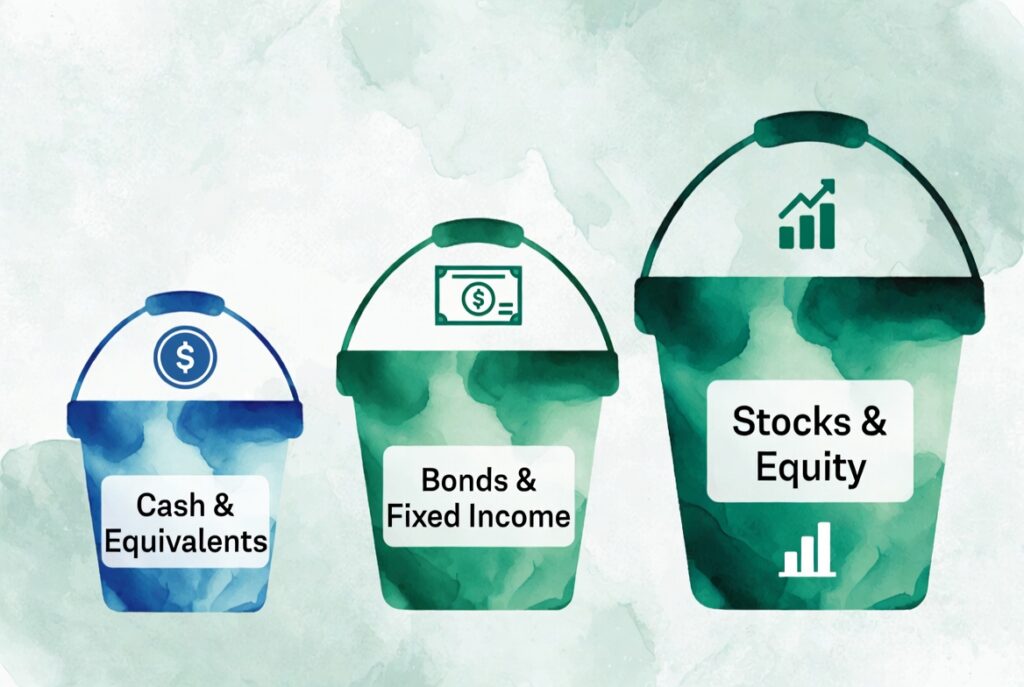
The bucket strategy divides your retirement assets into three time-segmented pools, each with a different purpose and risk profile.
The short-term bucket holds one to three years of living expenses in cash or near-cash equivalents. This is your income source in normal times and your safety valve during downturns. The medium-term bucket holds four to ten years of income needs in a mix of bonds and income-producing assets. Its job is to refill the short-term bucket over time. The long-term bucket holds your growth assets, primarily stocks, with a time horizon of eleven or more years. Because you will not touch this bucket for over a decade, it can absorb market volatility without forcing you to sell at a loss.
This structure gives every dollar a job. You are never forced to sell growth assets to pay this month’s bills because you have a funded short-term bucket to draw from instead.
The less your portfolio has to do, the less sequence risk it faces. Guaranteed income sources like Social Security, a pension, or an annuity payment do not fluctuate with the market. Every dollar of guaranteed income you have is a dollar your portfolio does not have to provide, which reduces both the withdrawal rate and the sequence risk.
This is one of the most important reasons why Social Security timing is a portfolio management decision, not just an income decision. A higher monthly Social Security benefit reduces your portfolio withdrawal rate, shrinks your sequence risk exposure, and provides income that continues regardless of what the market does.
For retirees who retire before age 70, one of the most effective sequence-risk strategies is to draw from the portfolio in the early years of retirement while delaying Social Security. The portfolio withdrawals fund living expenses during the delay period. When Social Security starts at a higher amount, it reduces the ongoing withdrawal rate permanently.
This is sometimes called a Social Security delay bridge. It does increase portfolio withdrawals in the early years, which requires a larger cash buffer, but the payoff is a higher guaranteed income floor for the rest of life, reducing sequence risk exposure over the long term.
A rigid 4 percent withdrawal with annual inflation adjustments does not account for what markets are actually doing. A flexible approach adjusts withdrawals based on portfolio performance. In good years, you may take slightly more. In bad years, you cut back on discretionary spending and let the portfolio breathe. Research shows that flexible withdrawal strategies can dramatically improve portfolio survival rates compared to rigid approaches, particularly at withdrawal rates of 4 percent or higher.
This does not mean eliminating all discretionary spending the moment the market dips. It means having a pre-committed rule: if the portfolio drops more than X percent in a given year, we reduce variable spending by Y percent that year. Deciding this in advance prevents emotional decisions in the middle of a downturn.
Annuities come in many forms, and not all of them are appropriate for every retiree. But for the specific problem of sequence risk, a properly structured income annuity (not a variable annuity with high fees) can be a powerful tool. By converting a portion of the portfolio into a guaranteed lifetime income stream, you reduce the withdrawal rate on the remaining invested assets and create an income floor that does not depend on market performance.
The tradeoff is liquidity. Money you annuitize is no longer available as a lump sum. For many retirees, the right approach is to annuitize enough to cover essential expenses (on top of Social Security), then keep the remainder invested for flexibility, growth, and legacy.
These are the questions I hear most from retirees and pre-retirees about managing market risk.
| Q: Does sequence of returns risk only apply after I retire? No, but it is most severe in the years immediately surrounding retirement. The “fragile decade” is generally the five years before and five years after your retirement date. During this window, your portfolio balance is at its peak, and you are either starting or have just started withdrawals, making early downturns especially damaging. |
| Q: What is the safe withdrawal rate in 2026?Morningstar’s 2026 base-case safe starting withdrawal rate is 3.9%, up from 3.7% in 2025. This assumes a portfolio with 30 to 50 percent in equities and a 30-year retirement horizon. More equity-heavy portfolios may support a lower rate due to higher volatility. Early retirees with 40-year horizons may need to start even lower, around 3.2 to 3.5%. |
| Q: How large should my cash buffer be? Most research suggests one to three years of living expenses in cash or near-cash equivalents (money market accounts, short-term Treasuries). Three years is more conservative and appropriate for retirees with higher equity allocations or during periods of elevated market uncertainty. One year may be sufficient for retirees with strong guaranteed income floors from Social Security or pensions. |
| Q: Should I be more conservative in my 60s to avoid sequence risk? A moderately conservative allocation can reduce sequence risk, but being too conservative introduces a different problem: inflation risk over a 25 to 30 year retirement. Most retirees benefit from a balanced approach, typically 40 to 60 percent equities at the start of retirement, declining gradually over time. The cash buffer and bucket strategy reduce sequence risk without requiring you to move entirely out of growth assets. |
| Q: Can I recover from a bad sequence early in retirement? It depends on how early, how severe, and how you respond. A retiree who draws from a cash buffer during the downturn instead of selling equities gives the portfolio time to recover. One who sells equities to fund withdrawals locks in losses and reduces the shares available for recovery. The strategy you have in place before the downturn determines whether you recover or not. |
| Q: How does delaying Social Security help with sequence risk? Delaying Social Security increases your guaranteed monthly income, which reduces the amount your portfolio must provide. A lower portfolio withdrawal rate means less exposure to sequence risk. When Social Security eventually starts at a higher amount, it acts as an income floor that continues regardless of market conditions. The tradeoff is higher portfolio withdrawals in the delay period, which requires a well-funded cash buffer. |
Sequence of returns risk is not a market prediction. It is a structural feature of the transition from accumulation to distribution. The first five years of retirement are the most critical, and the market does not care about your timeline.
The strategies that protect against sequence risk are not complicated. A cash buffer that funds living expenses during downturns. A bucket structure that matches each dollar to its time horizon. A guaranteed income floor through Social Security, pensions, or a properly structured annuity. Flexible withdrawals that reduce pressure on the portfolio when markets are stressed. And Social Security timing that maximizes the guaranteed income floor.
What these strategies have in common is that they all require planning before the downturn arrives. You cannot build a cash buffer after the market has already dropped 25 percent. You cannot delay Social Security once you have already filed. The decisions you make in the years before retirement, when markets are calm, determine whether you are protected when they are not.
If you are within ten years of retirement and have not stress-tested your plan against a bad early sequence, now is the time.
| Questions About Your Retirement Income Strategy or Portfolio Protection? John F. Davenport, Esq. and the team at Davenport & Associates help CT and NY families locally, as well as clients all across the country, stress-test their retirement plans against market downturns, build cash buffers and bucket strategies, and coordinate Social Security timing with their overall income plan. Click below to schedule your free 30-minute consultation. -> Schedule Your Free Consultation -> jdavenportassociates.com/contact-us |
| References & Sources HF Financial: What Market Volatility in 2026 Means for Retirement Income Planning (hffinancial.com) Morningstar: What Is the Retirement Risk Zone? April 2026 (morningstar.com) Morningstar: 2026 Safe Withdrawal Rate Research, 3.9% Base Case (morningstar.com) Charles Schwab: Sequence of Returns Risk Explained (schwab.com) Bluebird Advisory: Sequence of Returns Risk, Retirement Protection Guide, April 2026 (bluebirdadvisory.com) CNBC: Market Volatility and Retirement, Sequence of Returns Risk Explained, April 2026 (cnbc.com) |
| About the Author | John F. Davenport, Esq. John F. Davenport holds a law degree from Pace University and an MBA in finance from Fordham University, and his business degree from the University of Notre Dame. He is a licensed attorney in New York and Connecticut, and financial advisor. He founded Davenport & Associates in 1997 and has spent more than 30 years helping CT and NY families build retirement income plans and estate strategies that work together — not against each other. As both a licensed attorney and financial advisor, John reviews estate plans from both the legal and financial perspective in a single conversation — a combination most families would otherwise need two separate professionals to replicate. Davenport & Associates | 800 Connecticut Avenue, Suite E401, Norwalk, CT 06854 Phone: (203) 853-6300 | jdavenportassociates.com IMPORTANT DISCLAIMER: Educational only—not investment/tax/legal advice. No strategy guarantees results—vary by rates, markets, laws, personal circumstances. Consult advisors. |